Don't miss our holiday offer - up to 50% OFF!

Identify Agarwood Chips
When you compare prices from different sources to choose agarwood chips, you certainly want to buy real agarwood (who wouldn’t?). You can use a variety of different techniques. Here are just a few of them.
Disclaimer: This is based solely on my experience, and everyone may have different approaches. Please feel free to use the method that suits you.
Identifying agarwood by appearance and aroma
·Through its appearance

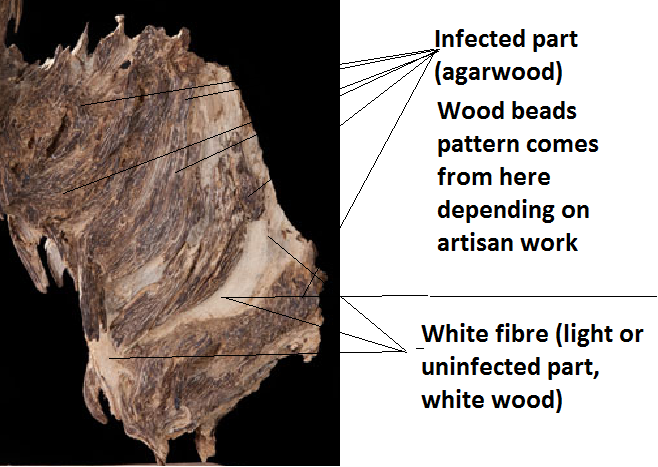
Multiple oil streaks can be seen (oil streaks: resin, dark lines around the wood). If you do not see any lines and only see solid color, it means someone has tampered with the wood.
·Through smell
Pick up a piece and smell it carefully. If there is a pungent, strong alcohol smell, it is very likely not real.
If you really want to buy it, please ask to take a sample home, and if that’s not allowed, buy a small piece to test:
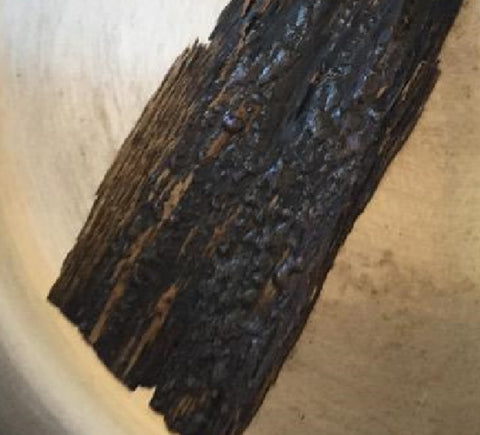
Heating: Do not burn directly. Place the wood chips on a piece of spoon, put the spoon under the fire or incense burner, and then observe. The more bubbles produced when the resin burns, the better the quality of the wood chips, and at the same time, the fragrance should also be very noticeable.

(The above picture shows the heated resin. The surface appears blackened and shiny due to the oils in the wood, which are released at high temperatures, emitting a woody fragrance)
This is another image of a small wooden chip with resin

Resin that shines after heating at 180 degrees for 10 minutes
Take a small sample. Immerse it in 200 milliliters of boiling water. If the liquid is no longer clear after a few minutes, it may be that an unscrupulous seller has played some ‘trick’ on the wood. It could be a dye or aromatic compound.
Let the wood dry. Wipe the wood with a small white cloth or paper towel. Check if it has any color changes, mainly black or dark colors.
You can place a small piece of agarwood sample in the flowerpot.

When ignited, you can see bubbles forming in the resin, and at this time, the fragrance of agarwood is released from the wood.
A quicker way to test Agarwood chips
please carry a mica plate, tweezers and a lighter around for testing.

Or you could also carry a battery operated incense heater Kodutu which is portable and extremely convenient

It should not take more than 2 minutes with seller’s sample.
Once the incense core is heated, the woody fragrance will rise. You will experience the sweet, woody scent of vanilla.
To learn about agarwood prayer beads, please click here.
Cultivated or Natural chip?
costly. However, there is a simple technique you could use:
There were no 100% answers on this unless you would bring it to the lab (the best method, click here)) which could be quite
Pay attention to the “hole” where agarwood forms around
Where does it come from? See below for side view.

Vertical view (internal infection)
A hole was drilled, and agarwood began to form around the wound, so the hole is very large. Why not drill a small hole? Although it is possible to drill, it is more difficult.

Through cultivation, infected agarwood will form cavities around the wounds to protect it from external invasions. The cavities are drilled or nailed with tools, so this is a significant feature of cultivated agarwood.

Wild wood chips (in this case, they come from Nha Trang, Vietnam) have multiple smaller holes, usually caused by insects or ants (please note, this is just a general guideline; if a seller wants to cheat, they will do anything to cover up their ‘product’)
Below are some horizontal and vertical views of naturally infected wood; the current inoculation techniques cannot produce this type of infection pattern (wild agarwood).


Generally, sellers store agarwood together. They usually classify these agarwood pieces according to the type of resin. You may have heard terms like ‘Agarwood Grade’, ‘Double King Grade’, ‘AAA’, etc. By observing multiple pieces of agarwood, you can notice different types of holes. Cultivated agarwood pieces have an average width of a few centimeters, while wild agarwood pieces usually have smaller holes.
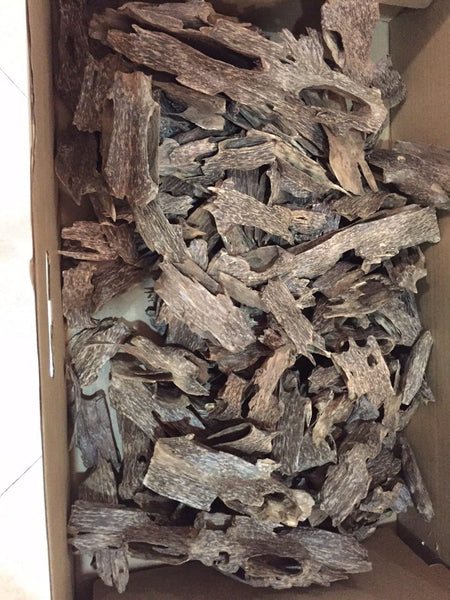
Compare the cultivated agarwood fragments (large drilled hole, open) with the picture below.

Wild Sumatra Agarwood chip (compared the holes, smaller, caused by insects, or fungi)
You may need to scroll up to see the cultivated wood chips in the first image (the size of multiple fragments and holes is larger than that of wild wood chips).
Large chunks of wild agarwood can be used for decoration, sculpting, and various religious beads. Agarwood powder produced during the process can be used to make incense and distilled essential oil.
The scent characteristics are also different; however, when using this method, you need to know what to pay attention to during sampling. For example, some ebony chips are sweeter, while others are spicier, or a mix of both. Either way, the experience should be pleasant. It is a good idea to carry a portable incense burner with you (for example, a Kodutu incense burner).
If fragments are collected above the hole or cut vertically, it is difficult to determine whether they are cultivated wood.
The agarwood on that tree is limited because there are only the framework. This tree is already dead, with multiple wounds, and cannot recover. The agarwood has been scraped off (collected) from this tree, leaving only the framework.
Finally, just to make a joke and let you know that there are many unethical scam sellers outside, please take a look at this ‘substandard’ grade of rock, wood, and plastic.

Sinking grade? Check open-end for woodchip. If it is solid, shake to see there is noise. Feel it. If in doubt, x-ray it.
